

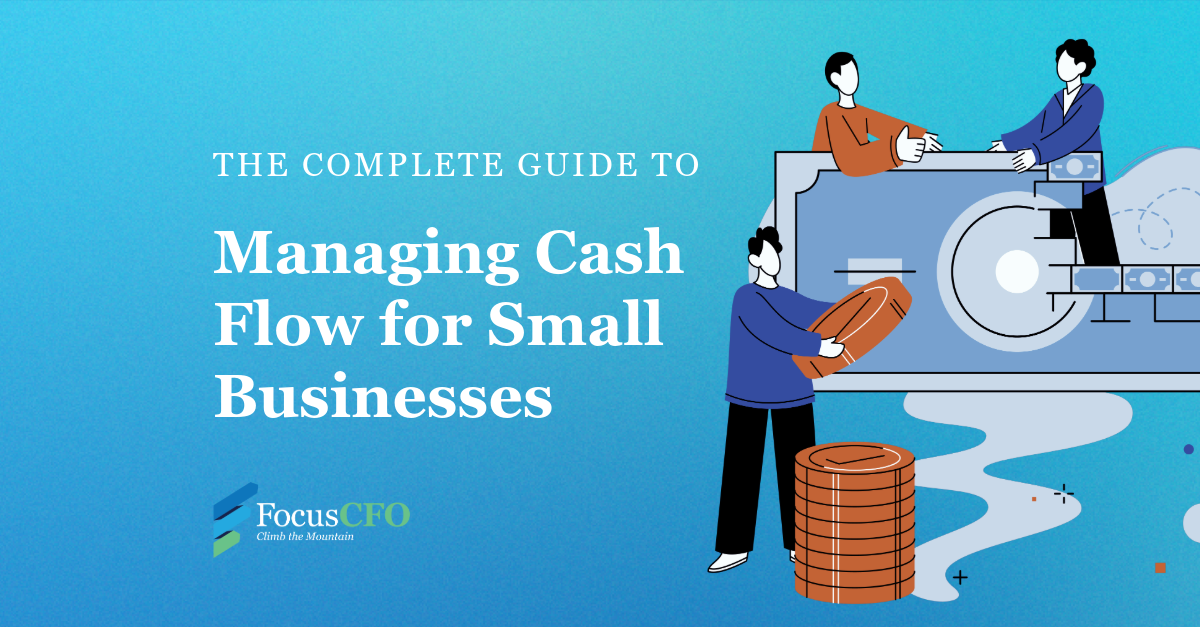
Everything small business owners need to know about cash flow — from the fundamentals to the tools and strategies that keep businesses financially healthy and growing.
In This Guide
Cash flow problems don't announce themselves in advance. One quarter, the business is profitable. The next, you can't make payroll. Many small business owners are surprised to discover that profitability and cash flow are two very different things — and confusing them is one of the most costly (and stressful!) mistakes a business owner can make.
Our fractional CFOs cumulatively have hundreds of years working with small and midsize businesses across the country to build sustainable, transferable value and maximize cash flow. We've compiled that knowledge into one essential guide to help business owners, like you, maximize cash flow and de-stress their lives. Think of it as the practical, no-jargon playbook you need to understand where your cash stands today, what threatens it, and how to build a system that protects it going forward.
📥 Free Resource: We've built a 13-week rolling cash flow template you can download and start using today. Get the free template →
What Is Cash Flow?
Cash flow refers to the money that flows in and out of a business. Money flows in through revenue; it flows out through expenses and investments. Businesses need to track those numbers to understand their liquidity, flexibility, and overall financial performance.
Assessing cash flow involves more than keeping an eye on your bank statements. Cash flow statements track the changes in a company's cash position over a specific period. Unlike an income statement — which shows profit or loss — a cash flow statement reveals the actual movement of cash into and out of the business.
"Many business owners report a profit on their income statement, but have difficulty making sure they have enough cash on hand to pay all obligations when due." — FocusCFO
In fact, data suggests that up to 95% of small business owners make critical financial decisions based on their bank balance alone. They think they're keeping close track of their company's financial performance — and yet they're missing a significant piece of the puzzle.
Cash Flow vs. Profit: Why Business Owners Confuse the Two
Your income statement might show a strong profit while your bank account tells a completely different story. This is one of the most disorienting experiences a business owner can face, and it happens because profit and cash flow measure fundamentally different things.
Profit is the difference between revenue and expenses on an accrual basis. It counts revenue when it's earned and expenses when they're incurred, regardless of when the literal money changes hands. Cash flow, by contrast, tracks the literal timeline of dollars moving in and out of your checking accounts.
Consider a simple example: if you invoice a client $50,000 in December but they carry net payment terms and don't pay until February, your December income statement looks outstanding. Your January bank account does not. Understanding this gap — and managing it proactively — is what separates financially resilient businesses from those that are perpetually scrambling.
The Three Sources of Cash in Your Business
Every dollar that enters your business comes from one of three places. Knowing which leverage points you actually control makes all the difference:
- Business Owners & Investors: Capital invested directly by founders, equity partners, or outside capital injectors. This is often the first source tapped in a structural crisis, but it is the most expensive as it dilutes ownership or creates personal financial liability.
- Your Bank (Debt Financing): Lines of credit, SBA loans, or commercial equipment financing. Commercial banking relationships matter immensely, and businesses that build them before they actually need them find themselves in a far stronger position than those that apply during an emergency cash crunch.
- Daily Operations (Internal Cash Flow): This is the most critical source — and the one corporate management has the most direct influence over. Cash generated organically from your operations is where your management team can create real, sustainable improvements at the lowest net cost.
The goal of professional financial stewardship is to optimize internal cash flow so that you rely on outside funding sources only strategically — for aggressive growth investments, never to plug operational holes.
Read more about the five steps to improve operational cash flow →
Reading Your Cash Flow Statement
The cash flow statement is the most revealing financial document in your business — yet most small businesses either don't generate one or don't know how to interpret it. Unlike a balance sheet or income statement, producing an accurate cash flow statement requires a deliberate process. It is organized into three foundational blocks:
- Operating Activities: Cash generated from the day-to-day running of the business — customer sales revenue coming in, payments to material suppliers going out. This section metrics whether your core business model is actually producing cash. Positive operating cash flow is the engine of corporate safety.
- Investing Activities: Cash related to the purchase or sale of long-term capital assets — infrastructure equipment, commercial property, or business acquisitions. Significant outflows here aren't inherently bad; they routinely reflect smart growth investments. The critical question is whether operating cash flow can support them.
- Financing Activities: Cash flows related to debt and equity positions — loan repayments, new borrowings, equity payouts, or stock issuance. This section shows how the business is capitalized over time.
The sum of all three sections equals the net change in your cash balance over the period. Reading these together — not in isolation — gives leadership the complete picture needed to safely build **sustainable, transferable value**.
Read Cash Flow Statement 101 for a comprehensive guide to reading your cash flow statement →

The Five Factors That Impact Your Cash Flow
Cash blockages don't occur randomly. They are driven by specific, identifiable factors — most of which sit entirely within your operational control to influence:
- Accounts Receivable (AR): How fast is money actually coming in? Extended payment timelines or sluggish collection practices leave you holding an asset on paper but with an empty wallet. Tightening your collection cycle is often the fastest way to stabilize capital.
- Accounts Payable (AP): What you owe, and exactly when you owe it. Negotiating favorable payment cycles with strategic vendors — so you have adequate time to match inflows without incurring compliance penalties — preserves vital operational flexibility.
- Inventory Management: Capital tied up in stagnant warehouse inventory is cash not working in your bank account. A disciplined inventory tracking system safely balances prompt customer fulfillment with careful cash preservation.
- Costs & Expenses: Every line-item cost carries a timing dimension. Large lump-sum insurance or software expenses can often be restructured into monthly installments to avoid massive single-month hits to capital.
- Revenue Timing & Seasonality: Predictable revenue dips require forward forecasting. Companies that navigate natural seasonal slowdowns well do so because they plan cash reserves months in advance, not weeks.
The 13-Week Rolling Cash Flow Forecast
If there's one tool that distinguishes financially confident small businesses from those perpetually in a state of reaction, it's the 13-week rolling cash flow forecast. This is not a budgeting exercise — it's an operational instrument that gives you a clear, weekly view of your true cash position three months out.
Why exactly 13 weeks? It's close enough to ensure real accuracy, yet far enough out to let you correct structural shortfalls before they become catastrophic emergencies. It rolls forward each week, so you always maintain a 90-day clear window of visibility.
Expected invoice collections, client deposits, and pipeline conversions mapped precisely by week.
Payroll runs, commercial rent, vendor obligations, and debt servicing mapped strictly by due date.
This forward-looking model allows your management team to anticipate structural friction points. Sales projections populate the inflow calculations, while a ledger of fixed and variable liabilities populates the outflow side. Reviewed weekly, this simple routine moves cash management from a defensive struggle to clear strategic oversight.
📥 Start Mastering Your Cash Flow: Get the free template →
Five Steps to Improve Your Cash Flow Starting Now
Understanding financial concepts is valuable, but the core execution matters most. Here are five practical steps, drawn directly from FocusCFO's hands-on work with scaling small businesses. See the full breakdown of each step →
- Build Your Rolling Cash Flow Projections: Start with the 13-week forecast spreadsheet. Populate your current starting balance, pull expected collections from your AR aging reports, and input every known business liability for the next 90 days. Don't let perfection stall your first iteration.
- Tighten Accounts Receivable: Audit your invoice operations. Are invoices deploying immediately upon delivery? Are payment milestones firm? Consider implementing early payment terms or automated payment reminders to accelerate cash cycle velocity.
- Negotiate Smarter Payment Terms with Vendors: Most commercial vendors will extend payment windows if requested nicely by a long-standing partner. Converting Net-30 accounts to Net-45 or Net-60 keeps your money working for you longer.
- Conduct a Granular Operational Analysis: Research indicates that workflow bottlenecks and operational inefficiencies cost scaling companies roughly 20–30% of their top-line revenue annually. Optimizing your core operating cycles often unlocks massive cash flow improvements without slicing real capability.
- Understand Your Profitability by Customer: Not all revenue is healthy. Some accounts pay promptly and require zero management overhead; others are slow-paying, high-maintenance drains on your energy. Separating these tiers lets you focus growth on the most accretive relationships.
Why Cash Flow Management Is Vital for Small Businesses
Active cash positioning dictates whether an enterprise can comfortably satisfy its contractual obligations, survive sudden economic downturns, capitalize on strategic expansions, and maintain financial stability. It answers the everyday questions that keep founders awake:
- Can my current accounts cover the upcoming payroll cycle?
- Can I fulfill vendor bills on time to maintain credit positioning?
- Have we accurately set aside cash for our corporate quarterly tax liabilities?
The Dangers of Poor Cash Flow Management
The macro statistics are alarming: 82% of small businesses that collapse cite cash flow failure as a primary cause. Despite this, cash flow analysis remains the least-reviewed function in mid-market management, frequently hidden behind the illusions of an accrual profit sheet.
Surveys show that 71% of business owners suffer severe personal stress, chronic anxiety, and burnout due to cash constraints, directly resulting in missed expansion opportunities and canceled growth initiatives.
Critical Warning Signs to Monitor:
- Routinely leaning on an emergency line of credit just to pass payroll.
- Pushing vendor invoice settlements past due dates on a recurring basis.
- Steering business strategy based on checking balances rather than predictive modeling.
- Inability to answer "Can we afford to expand headcount next month?" with statistical backing.
When to Bring in Expert Financial Leadership
At some point, managing cash flow well outgrows what a bookkeeper or part-time accountant can provide. Building a reliable 13-week forecast, identifying where cash is leaking, strengthening your banking relationships, and turning your numbers into a clear path forward — that's the work of an experienced CFO.
For most small businesses, a full-time CFO hire doesn't make sense yet. A fractional CFO does. Our associates bring decades of experience working in businesses like yours — not just for them. They embed directly with you and your team, providing the guidance, knowledge, and hands-on support to help you manage cash confidently and build a business with sustainable, transferable value.
At FocusCFO, cash flow is at the core of everything we do with our clients. If you're ready to stop guessing and start leading with clarity, we'd love to start a conversation. Reach out today for a complimentary half-day assessment.
Ready to Take Control of Your Cash Flow?
Start with our free 13-week rolling cash flow template — then schedule a consultation to see how a FocusCFO fractional CFO can help you build a stronger financial foundation.
Download the Free 13-Week Cash Flow Template → Schedule a Consult →
Related Reading